sat suite question viewer
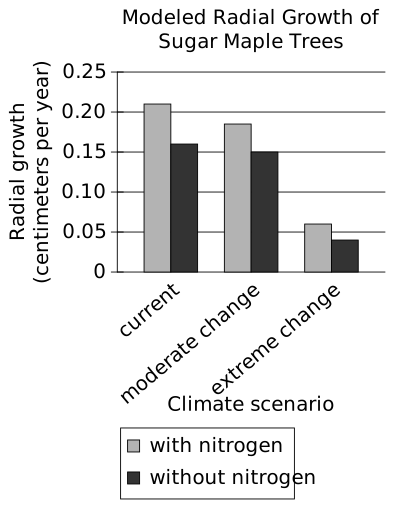
- For each data category, the following bars are shown:
- with nitrogen
- without nitrogen
- All values are approximate.
- The data for the 3 categories are as follows:
- current:
- with nitrogen: 0.21 centimeters per year
- without nitrogen: 0.16 centimeters per year
- moderate change:
- with nitrogen: 0.19 centimeters per year
- without nitrogen: 0.15 centimeters per year
- extreme change:
- with nitrogen: 0.06 centimeters per year
- without nitrogen: 0.04 centimeters per year
- current:
Inés Ibáñez and colleagues studied a forest site in which some sugar maple trees receive periodic fertilization with nitrogen to mimic the broader trend of increasing anthropogenic nitrogen deposition in soil. Ibáñez and colleagues modeled the radial growth of the trees with and without nitrogen fertilization under three different climate scenarios (the current climate, moderate change, and extreme change). Although they found that climate change would negatively affect growth, they concluded that anthropogenic nitrogen deposition could more than offset that effect provided that change is moderate rather than extreme.
Which choice best describes data from the graph that support Ibáñez and colleagues’ conclusion?
Explanation
Choice D is the best answer because it describes data from the graph that support Ibáñez and colleagues’ conclusion that increasing anthropogenic nitrogen deposition can compensate for the negative effect of climate change on tree growth if that change is moderate but not if it’s extreme. The bar graph shows the growth of sugar maple trees with and without nitrogen fertilization under three different climate-change scenarios: current conditions, a moderate change, and an extreme change. According to the graph, radial growth without nitrogen fertilization is projected to be about 0.16 centimeters (cm) under current conditions, 0.15 cm under a moderate change, and 0.04 cm under an extreme change. The graph also shows that with nitrogen fertilization, growth is projected to be about 0.18 centimeters under a moderate change but only about 0.06 centimeters under an extreme change. Thus, the data in the graph support the researchers’ conclusion by showing greater growth for a moderate change using nitrogen fertilization than they do either under current conditions without nitrogen fertilization or under an extreme change with nitrogen fertilization.
Choice A is incorrect. Although it accurately represents the data in the graph, this fact pattern doesn’t support Ibáñez and colleagues’ conclusion that the decline in radial growth due to climate change will be partly offset by higher levels of anthropogenic nitrogen, but only if change to the climate is moderate and not if it’s extreme. To support this would require comparing radial growth without nitrogen fertilization under current climate conditions to the growth with nitrogen fertilization under both moderate and extreme changes. This choice mentions only growth with nitrogen fertilization under current climate conditions and moderate change and growth without nitrogen fertilization under an extreme change, which don’t provide a basis to determine whether higher nitrogen in the future will be able to offset reduced growth due to climate change. Choice B is incorrect. Although it accurately represents the data in the graph, this fact pattern doesn’t support Ibáñez and colleagues’ conclusion that the decline in radial growth due to climate change will be partly offset by higher levels of atmospheric nitrogen, but only if change to the climate is moderate and not if it’s extreme. The support needed would compare radial growth under current climate conditions without nitrogen fertilization to the growth with nitrogen fertilization under moderate and extreme changes. This choice mentions only growth without nitrogen fertilization under current conditions and moderate change and growth with nitrogen fertilization under extreme change, which don’t provide a basis to determine whether higher nitrogen in the future will be able to offset reduced growth due to climate change. Choice C is incorrect. Although it accurately represents the data in the graph, this fact pattern doesn’t support Ibáñez and colleagues’ conclusion that the decline in radial growth due to climate change will be partly offset by higher levels of atmospheric nitrogen, but only if change to the climate is moderate and not if it’s extreme. The support needed would compare radial growth without adding nitrogen under current climate conditions to the growth with nitrogen fertilization under moderate and extreme changes. This choice mentions only the growth with and without nitrogen fertilization under moderate climate change and growth without nitrogen fertilization under extreme change, which don’t provide a basis to determine whether higher nitrogen in the future will be able to offset reduced growth due to climate change.